[NB. This blog post is written by myself (Karen) & Billy Craig (https://www.billycraig.co.uk/ ) ]
On Fri 13th Jan I went to see Billy to get a Resting Metabolic Rate (RMR) test done. What is that you ask? It’s a test that measures how many calories your body uses at rest, say for example if you were on bed rest and not doing anything at all that requires extra energy for body or brain. So just the calories required for vital physiological functions, biochemical processes (e.g. dissipation of energy as heat) and reparative processes (growth and development) (Consistent Eating, Chapter 4: Metabolism, Billy Craig https://www.amazon.co.uk/dp/1507543255/ )
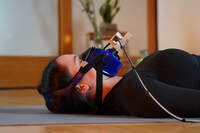
The test requires you to be fasted so once I’d finished my breakfast that was it. I was driving to Derby with no snacks! Typically you’d be fasted overnight but there was no way I was driving all the way to Derby fasted and hangry 🤣 so we agreed on this protocol of being 4 hours fasted and that way we can use the same protocol to compare data from another test. I arrived at Billy’s house just after 12.30 (thankfully the drive was straightforward and the traffic wasn’t too bad) and the first thing he did was explain the test and show me the mask that you need to put on. There is also a strap that you need to put around your chest that monitors heart rate. After that I had to sit back and relax for a while (20 mins) to try and get my body into a rested and calm/unstressed state. Once you’re all nicely relaxed you put the mask on and there is a strap to pull until it’s tight enough that no air leaks out. I know some people are worried about this feeling restrictive to your breathing but it truly isn’t. It feels a little weird initially to have a sealed mask around your nose and mouth but once it’s tightened and you start breathing there is no difficulty and in fact it feels really easy to breathe (something that you want lol!)
The mask is hooked up to the specialist equipment and to Billy’s laptop, where the data is sent. The test analyses your exhaled gases and will tell you how many calories you’re burning at rest (your RMR) and what percentage of your fuel source is coming from fats and carbohydrates.
A standard test takes around 10 mins in the mask (time for calibration and for testing), mine was a little longer (15 mins) as there was a data point that looked a little odd (not unlike myself lol) so Billy left it a few more mins. After that it spits out a number at you, which for me was 2050 cals, but the data goes to pnoe.com for analysis and they produce a report for you. After that you can ask Billy some questions but word to the wise, take a drink & snacks or something if you want your brain to keep up with his answers! He is full of super information and answered questions for me about my metabolic rate, how much to eat, when is best to eat around training and then moved on to weightlifting advice. Next time I go I’m taking a recording device lol. By the time I left I could’ve eaten my own arm off, I was that hungry. Luckily, just down the road from Billy’s there’s a nice marina and I drove straight there for food and drink which I virtually inhaled.
The report arrived the next day and, just as I thought, the 2050 cals was a bit too good to be true! That was probably due to the odd data point and my actual RMR was 1683 cals/day, which did sound more likely (lower but still pretty good). This is the number of calories my body would need each day just to keep me lying in bed doing nothing. By my rough calculations I eat between 2,500 & 2,700 cals/day but that’s a post for another day. Obviously I need to eat more than 1683 cals/day to sustain general activity and more again for weightlifting but the amount of calories I eat already covers that.
So why would we want to know our resting metabolic rate? It’s a handy place to start when thinking about how much you want to be eating for whatever goals you have. I still have quite a lot of weight (mostly on my belly) that, although I’ve made my peace with, I would love to lose. I didn’t want to cut calories though because I’ve only just got to a place where my anxiety isn’t anywhere near as bad as it was, my sleep is generally better and I actually have some energy (when I’m not overdoing things). I didn’t want to risk upsetting that state of affairs so instead decided on weightlifting (for the benefits in a previous blog post), therefore expending more energy but not in a breathless state (excessive cardio etc.) & building muscle, which will hopefully change my body composition (over time) to less fat and more muscle. I wanted to check that my RMR was in a reasonable place before continuing with the weightlifting. If you already have shaky foundations (poor metabolic rate, running on stress hormones etc.) then you’re not going to build much muscle and are probably just going to end up more tired than you started!
RMR only tells part of the story. If we really want to look at our energy needs we can work out our RMR per kg of bodyweight:
My RMR rate = 1683 cals/day
My weight = 78.1 kg
RMR/kg = 1683 / 78.1 = 21.5 cals/kg
Normal would be around 25 cals/kg so mine isn’t too bad. If someone had the same weight as me but ate drastically less and therefore had a lower metabolic rate, say 1200 cals/day, their cals/kg would reduce to 15.4 cals/kg, so they have a lower requirement for energy. Obviously the higher the better, indicating a higher metabolic rate. If we only have RMR then someone with a result of 1700 cals/day might look to have a pretty good metabolic rate but if their weight was 100 kg then their rate per kg would only be 17 cals/kg. Suddenly it’s not looking as good.
My use of the RMR would be to ignore the generally accepted activity multipliers (pp35 in Consistent Eating) that have no evidence base:
RMR x 1.2 = sedentary
RMR x 1.375 = lightly active
RMR x 1.55 = mod active
RMR x 1.75 = very active
RMR x 1.9 = extremely active
And would instead use the one from pp37 that has an evidence base.
For example, if we assumed you were sedentary (i.e. not trying to drain yourself) then 1683 x 1.2 would give you 2019 kcals using the formula that is used by sites such as myfitnesspal.com. Using the better one would give you 1683 x 1.40-1.69
Clinically one might suggest a test subject take the higher end (1.69) if you see signs of psychological stress etc. despite working in what is classically termed sedentary.
The result could be between 2356.2 and 2692.8 kcals. Someone who intended to utilise a calorie deficit would see a drastic difference in their ability to stick to it depending on whether they had judged they needed 2019 or 2692 kcals. Equally training outcomes would be very different with the variance in energy intake.
My RMR rate = 1683 cals/day
My weight = 78.1 kg
RMR/kg = 1683 / 78.1 = 21.5 cals/kg
Normal would be around 25 cals/kg so mine isn’t too bad. If someone had the same weight as me but ate drastically less and therefore had a lower metabolic rate, say 1200 cals/day, their cals/kg would reduce to 15.4 cals/kg, so they have a lower requirement for energy. Obviously the higher the better, indicating a higher metabolic rate. If we only have RMR then someone with a result of 1700 cals/day might look to have a pretty good metabolic rate but if their weight was 100 kg then their rate per kg would only be 17 cals/kg. Suddenly it’s not looking as good.
My use of the RMR would be to ignore the generally accepted activity multipliers (pp35 in Consistent Eating) that have no evidence base:
RMR x 1.2 = sedentary
RMR x 1.375 = lightly active
RMR x 1.55 = mod active
RMR x 1.75 = very active
RMR x 1.9 = extremely active
And would instead use the one from pp37 that has an evidence base.
For example, if we assumed you were sedentary (i.e. not trying to drain yourself) then 1683 x 1.2 would give you 2019 kcals using the formula that is used by sites such as myfitnesspal.com. Using the better one would give you 1683 x 1.40-1.69
Clinically one might suggest a test subject take the higher end (1.69) if you see signs of psychological stress etc. despite working in what is classically termed sedentary.
The result could be between 2356.2 and 2692.8 kcals. Someone who intended to utilise a calorie deficit would see a drastic difference in their ability to stick to it depending on whether they had judged they needed 2019 or 2692 kcals. Equally training outcomes would be very different with the variance in energy intake.

Hopefully that helps you to see how the RMR test can be useful for you. You may need to adjust your calories (or your output) if you start to do more exercise and then feel ridiculously tired (as I did lol). In my case I decided not to play with calories but to lower the amount of weightlifting (or actually to be truthful, to stop the amount of dancing around I was doing in between sets when I was supposed to be resting 🤣) I have set myself a strict hour limit now for my weightlifting so I can get a few sets of 3-4 different exercises in with reasonable breaks between sets, and I don’t leave my conservatory red in the face and falling down tired! So far this seems to be working for me 😁 I’ll keep you posted!
 RSS Feed